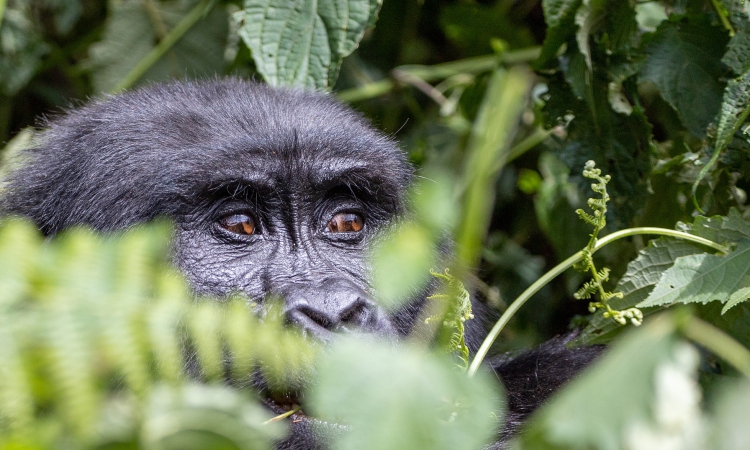

Mountain Gorilla Behavior and Adaptations – Mountain gorillas are one of the Eastern gorilla subspecies living in Volcanoes National Park in Rwanda, Bwindi, and Mgahinga National Parks in Uganda, and Virunga National Park in the Democratic Republic of Congo.
These magnificent creatures are the closest relatives to humans, apart from chimpanzees and baboons.
As their name suggests, mountain gorillas inhabit the rain-forests of the Virunga Mountains at altitudes between 1,000 ft and 13,000 ft.
The primary predators of these primates are humans, mainly hunting them for bush-meat. Mountain gorillas have longer hair than Eastern lowland gorillas and are slightly larger than other gorillas, with shorter arms.
The average weight of a male gorilla is about 170 kg, with a height of 1.55 m, while a female typically weighs around 80 kg, with a height of 1.35 m.
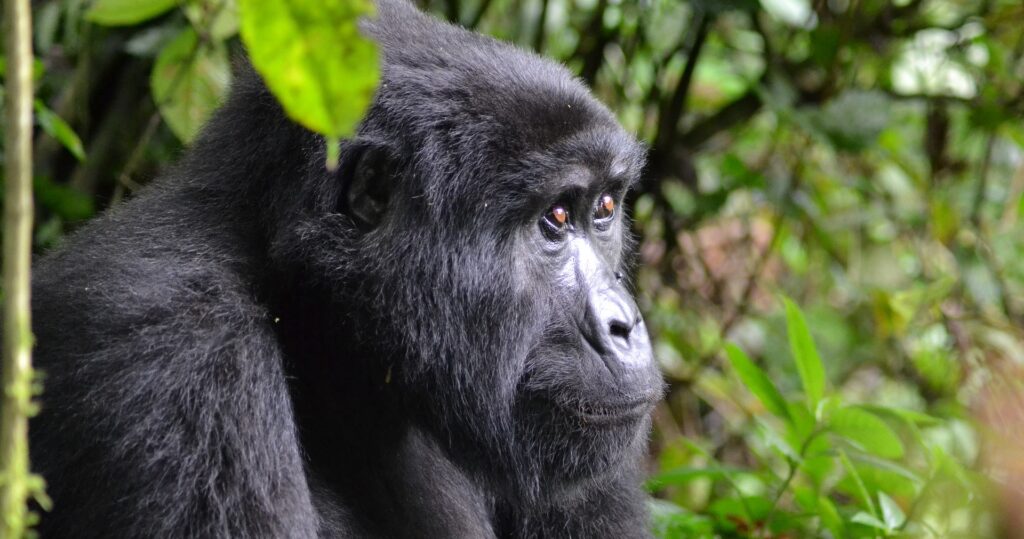
Behaviors of Mountain Gorillas
- Mountain gorillas live in groups called families and each group has about 20 individuals led by a male dominant silverback.
- Mountain gorillas play with each other and this is usually seen amongst the young ones for example chasing themselves and wrestling.
- Mountain gorillas communicate using vocalizations such as roars , grunts , chirps and also display body language like chest bearing and facial expressions.
- Mountain gorillas are herbivores that feed on a variety of plants , fruits , insects , leaves roots and stems .
- Mountain gorillas move and locomote by knuckle – walking on all the two legs and 2 hands , climbing and swinging through trees and walking upright for shorter distances.
- Mountain gorillas defend and protect their families from external threat from other gorillas or animals and internal threat from other silverbacks who want to dominate the family.
- Mountain gorillas sleep and rest in nests made of leaves and branches both during day and at night.
Adaptations of Mountain Gorillas
- Mountain gorillas have thick and longer fur that enables them to keep warm and from insect bites.
- Mountain gorillas have strong arms well -suited for breaking shells of fruits and for locomotion.
- Mountain gorillas have flat teeth that enable them chew and grind cellulose in their vegetation diet.
- Mountain gorillas are herbivorous animals which enables them to feed on vegetation thus maintaining good health.
- Mountain gorillas use vocalizations and display body language for easier communications with other group members.
Best time to visit gorillas
Trekking is acceptable all the year around but the best season is the dry season in the months of January to February and May to September.
Remarkably, mountain gorillas have evolved robust adaptations including powerful physiology and ingenious foraging strategies to thrive in their challenging alpine habitat.