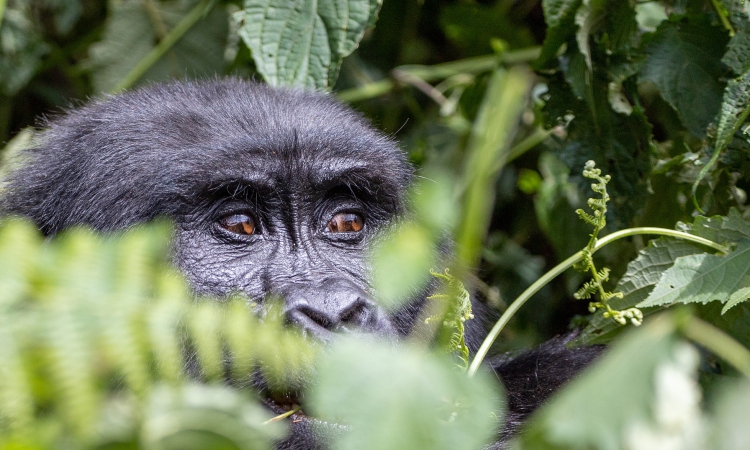

Do Mountain Gorillas Live in Families? People have families, and mountain gorillas have families too. A family or group of mountain gorillas is referred to as a troop. Each troop consists of between 5 and 30 individuals. Mountain gorillas hardly ever live alone; living in a family or group is safer.
Being social animals, gorillas usually form harems, where a male silverback lives together with many adult female gorillas and their young ones. However, in the case of mountain gorillas, about 40% of the groups accommodate a number of adult males who are closely related.
The family or group is led by a dominant male known as the silverback. The name “silverback” is because of the silvery back patches that indicate full adulthood.
The silverback is basically the largest gorilla in the group, and he guides the group through the forest, protecting them from harm. He barks and hoots as he organizes the day’s activities, which often include eating, nestling in leaves, and moving within a home range of roughly 16 square miles.
A gorilla family travels together, and they tend to sleep in the same location. He is the focus of attention during rest sessions, and younger gorillas tend to stay close to him, also involving him in their games.
Since females outnumber males in these groups, many males remain alone in the forest.
These lonely individuals make up 5% to 10% of the total gorilla population; however, in some cases, the male mountain gorillas form an all-male group. The mountain gorilla groups greatly differ in size; that is to say, an average group of gorillas consists of four to ten individuals.

The largest gorilla group ever recorded was found in Rwanda’s Volcanoes National Park and had 65 individuals for a short period of time. In case a group leader dies, the mountain gorilla group breaks up or a subordinate male silverback takes over, usually the son of the dead leader.
The strong relationships within the group play an important role in the development of young gorillas; for example, when a weaned young gorilla loses its mother, the entire group, but especially the leading male silverback, takes over the mountain responsibilities.
In a mountain gorilla group, there are usually a handful of male gorillas known as black-backs who are younger than the silverback because their fur has not yet turned silvery.
The rest of the family is made up of several female gorillas, youngsters, and baby gorillas. One of the most interesting facts about mountain gorillas is that a single silverback has all the right to own all adult females within the family.
Therefore, no male gorilla can go any closer to the females, and any attempt by a different silverback to come near the females will automatically result in a fight.
A dominant silverback mates with all the females in the group, so he is the father of all the baby gorillas in the family. Just like in a human home, there cannot be two fathers in one home.

When male gorillas reach the age of 11, they leave their family; however, it is difficult for them to join any other group that is already established because they are seen as enemies to other groups.
Adult males spend the first part of their life in isolation until they attract females and form their own group. Females usually leave their groups at the age of 8 to join a new group formed before breeding.
Interactions between gorilla groups are endlessly fascinating because males ought to do a lot of things at once, such as protecting their group members, attracting females from other groups, and trying to keep their females by preventing them from leaving the group.
No wonder interactions can be very intense, with a lot of male posturing and displaying, but interactions can also be with groups interacting for hours at a time.
In conclusion, mountain gorillas are basically family-based; they live and work together, although males find it hard to find an already established group, and it is also difficult to form their own groups when they grow up because they are seen as enemies by the males in other groups.