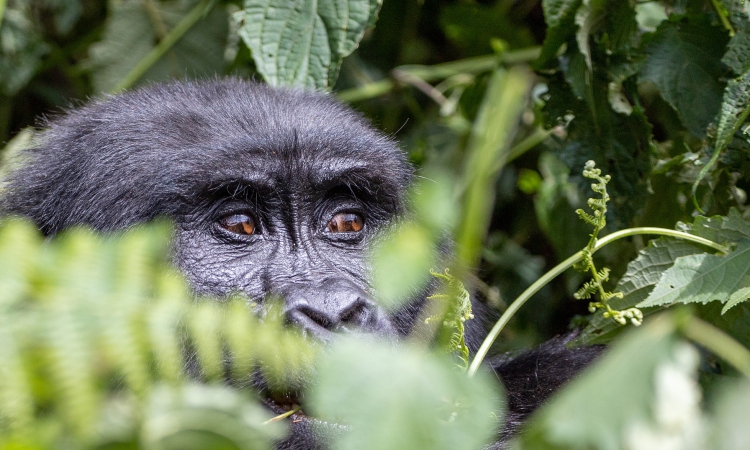

Mountain gorillas are found only in the Virunga Mountains, across three national parks in three countries: Volcanoes National Park in Rwanda, Virunga National Park in the Democratic Republic of Congo, and Bwindi and Mgahinga National Parks in Uganda.
The mountain gorilla is classified as an endangered species, with about 1,000 individuals remaining across these countries. Their numbers have declined over the years due to poaching, habitat loss from settlement and cattle grazing, and disease.
These gorillas can be seen on gorilla trekking tours.

Mountain Gorilla Conservation Status: IUCN Classification
The IUCN mountain gorilla status was reclassified in 2018 from Critically Endangered to Endangered, marking one of the few positive shifts in gorilla conservation status among all great ape subspecies.
While the mountain gorilla endangered status still reflects a fragile population, the improvement from Critically Endangered recognized decades of sustained conservation work across Rwanda, Uganda, and the Democratic Republic of Congo.
The conservation status of mountain gorilla populations is reviewed periodically by the IUCN, based on data gathered through regular population census work carried out jointly by park authorities and conservation organizations.
This is a notable contrast to the gorilla extinction status faced by other great ape populations, most of which continue to decline due to habitat loss and human pressure. Western lowland gorilla threats and eastern lowland gorilla conservation challenges, for example, remain more severe, with both subspecies still classified at higher risk than the mountain gorilla.
History of Mountain Gorilla Conservation
Conservation efforts for mountain gorillas began in the 1970s with Dian Fossey, a scientist who studied the life and behavior of mountain gorillas and helped establish the first procedures to protect them.
Fossey founded what is now known as the Dian Fossey Gorilla Center, based at the Karisoke Research Center in Rwanda’s Volcanoes National Park, which became the base for decades of gorilla monitoring and anti-poaching work. Her research also drew international attention to the mountain gorilla’s declining numbers at a time when very little was known about the species.
Conservation work is now carried out by the governments of Rwanda, Uganda, and the Democratic Republic of Congo, alongside mountain gorilla organizations including the African Wildlife Foundation, Fauna & Flora International, and the World Wide Fund for Nature (WWF).
National bodies such as the Uganda Wildlife Authority and the Rwanda Development Board also play a central role in day-to-day conservation work, from ranger deployment to permit management.
These combined efforts led to the creation of the International Gorilla Conservation Program, active since 1991. The program coordinates conservation work across all three countries where mountain gorillas live, since gorilla families often range across national borders.
This cross-border coordination has been essential, since a gorilla family protected in one country can move into a neighboring country within days, requiring shared monitoring and enforcement standards.
Mountain Gorilla and Silverback Population Trends
Mountain gorillas were once thought to be heading toward extinction. Population estimates in the late 20th century put the total number as low as a few hundred individuals across all three countries.
Sustained conservation work has since reversed that trend. Regular population census efforts have tracked a gradual increase in mountain gorilla numbers over the past several decades, including growth in the silverback gorillas population, the dominant males that lead each family group.
Silverback gorilla conservation status is tracked alongside overall population figures, since a stable number of breeding-age silverbacks is a key indicator of a healthy, self-sustaining population.
This recovery is considered one of the few positive outcomes among the world’s great ape populations, most of which continue to decline due to habitat loss and human pressure.
Population monitoring remains an ongoing part of conservation work, since tracking individual gorilla families over time helps researchers detect health issues, monitor births and deaths, and measure the overall success of conservation methods.
Mountain Gorilla Conservation Methods
- Training and deploying park rangers to protect gorillas from poachers, armed groups, and wildfires, a core part of ongoing gorilla protection efforts.
- Regular ranger patrols across the parks to monitor gorilla families and overall park conditions.
- Enforcement of laws related to mountain gorilla protection within each country.
- Veterinary and public health teams that monitor and treat gorilla health issues.
- Gorilla trekking rules that limit group size, distance, and contact to reduce the risk of disease transmission from humans to gorillas.
- Land purchases for gorilla habitat, including a 2018 acquisition by the African Wildlife Foundation, which was donated to Rwanda to expand its gorilla reserves.
Ranger patrols are one of the most resource-intensive parts of mountain gorilla conservation, since patrols happen daily across dense, mountainous terrain that is difficult to access. Rangers track gorilla families, remove snares set for other wildlife that can injure gorillas, and respond to signs of illegal activity within the parks.
Veterinary intervention is used carefully and only when necessary, since conservation teams aim to keep gorilla behavior as close to natural as possible. When intervention is required, such as removing a snare from an injured gorilla, specialized veterinary teams are deployed under strict protocols.
Organizations Working to Save the Gorillas
A number of gorilla protection organizations work alongside national governments on mountain gorilla conservation efforts.
The Dian Fossey Gorilla Center, one of the longest-running mountain gorilla conservation efforts in the region, continues research and field protection work that began with Fossey’s original studies.
Other groups, sometimes referred to collectively under save the gorillas foundation initiatives, run community outreach, anti-poaching, and habitat protection programs across all three range countries.
A mountain gorilla conservation fund model is commonly used to channel tourism revenue, permit fees, and donor contributions directly into ranger salaries, veterinary care, and community development projects near the parks.
These mountain gorilla organizations coordinate closely with national wildlife authorities to avoid duplicated efforts and ensure conservation funding reaches the areas with the greatest need.
Why Mountain Gorilla Conservation Matters
- Mountain gorillas play a vital role in their ecosystem by dispersing seeds and creating pathways used by other animals.
- Gorilla tourism generates revenue that supports national economies and funds local social services.
- Mountain gorillas are important to scientific research, helping researchers understand primate biology and its relevance to human health.
- Protecting mountain gorillas also protects their habitat, including rain forests that support broader environmental sustainability.
- Cross-border conservation work has strengthened cooperation between Rwanda, Uganda, and the Democratic Republic of Congo.
The ecological role of mountain gorillas extends beyond seed dispersal. As large herbivores, they shape vegetation growth patterns within the forest, which in turn affects the habitat available to smaller species living in the same ecosystem.
The economic case for conservation is significant as well. Gorilla trekking permit revenue funds a meaningful share of each country’s national park budgets, and a portion of permit fees is directed to communities living near park boundaries, which helps build local support for conservation rather than resentment toward restricted land use.
Community Involvement in Mountain Gorilla Conservation
Local communities play a growing role in mountain gorilla conservation, since long-term protection depends on cooperation from people living alongside the parks.
Revenue-sharing programs direct a percentage of park entry and permit fees toward community projects, including schools, health centers, and clean water infrastructure near park boundaries.
Some communities also participate directly in conservation work, serving as trackers, porters, and guides, which creates a direct economic incentive to protect gorillas rather than encroach on their habitat.
Community-based tourism initiatives, such as cultural village visits near Volcanoes National Park, further connect conservation funding to local livelihoods, reinforcing the link between a healthy gorilla population and community wellbeing.
How Trekking Rules Support Conservation
Gorilla trekking rules exist primarily to protect gorilla health and reduce disturbance to their natural behavior, making them a direct extension of mountain gorilla protection work.
- Visitors must maintain a safe distance from the gorillas at all times.
- Trekking groups must stay quiet to avoid disturbing the gorillas.
- Flash photography is not permitted during treks.
- Eating and drinking near the gorillas is not allowed.
- Children under 15 years old are not permitted to trek, since younger children are more likely to carry illnesses gorillas could contract.
These rules exist because mountain gorillas share close genetic similarity with humans, which means they are susceptible to many of the same respiratory illnesses. A minor human cold can pose a serious health risk to a gorilla family with no natural immunity to it.
Group size limits during treks serve a similar purpose, reducing the overall level of human contact any single gorilla family experiences in a given day.
Ongoing Threats to Mountain Gorilla Conservation
Despite decades of progress, mountain gorilla threats remain an active concern, and conservation status can shift if protections weaken.
Habitat remains limited, since mountain gorillas exist only within a relatively small area of protected forest across three countries. Population growth is constrained by the amount of suitable habitat available, regardless of how effective protection efforts are.
Political instability in parts of the region, particularly in the Democratic Republic of Congo, has periodically disrupted conservation and monitoring work in Virunga National Park.
Disease transmission risk remains a persistent concern, which is why trekking rules and health screening protocols continue to be enforced and updated as needed.
Climate change is an emerging concern for long-term habitat stability, as shifting rainfall patterns and temperature changes could affect the vegetation mountain gorillas depend on.
Mountain gorilla conservation is one of Africa’s clearer conservation success stories, built on decades of work by governments, gorilla protection organizations, and local communities. As a result, mountain gorilla numbers have grown steadily since the lowest population estimates recorded in the 20th century, even as challenges around habitat, disease, and regional stability continue to shape the work ahead. Book a gorilla trekking tour through a trusted Rwanda tour operator to see conservation efforts firsthand and directly support the work protecting this endangered species.