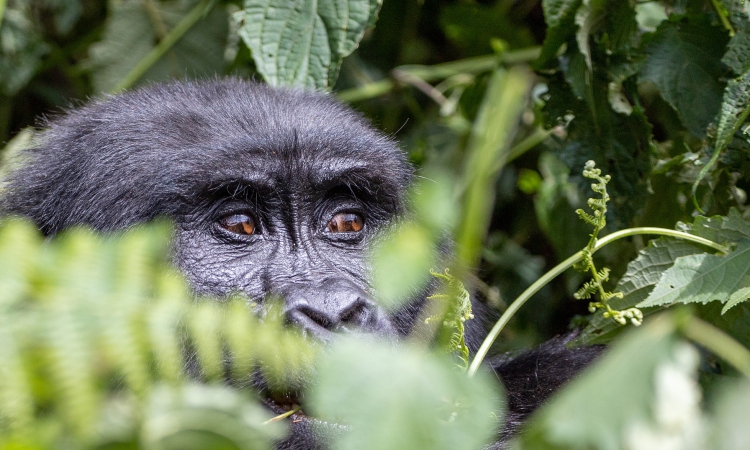

How Do Gorillas Adapt to Their Environment? Primarily terrestrial, gorillas walk on all fours by curling their fingers under and walking on their knuckles, a method called knuckle-walking.
This makes it easy for them to fell trees and access food.
Gorillas communicate with over 20 vocalizations, including roars, grunts, whistles, and barks.
Their opposable thumbs and big toes allow for climbing, grasping, and manipulating objects, along with different body languages, making it easy for them to portray their emotions, desires, and feelings to each other.
A bony sagittal crest on top of the head supports strong jaw muscles and teeth, which are used to grind coarse vegetation.
Their stomachs are larger than their chests due to enlarged intestines needed to digest cellulose in plants.
As diurnal animals (active during the daytime), gorillas rely on keen eyesight with excellent depth perception and color vision for easy locomotion.
Tufts of white hair on baby gorilla bottoms allow mothers to see them in the dense forest and keep them protected.
Gorillas do not chase after prey but instead remain within their vegetation, which keeps them safe from traps.
In conclusion, different gorilla adaptations keep them fit for their survival.

More about Gorillas
Gorillas are predominantly ground-dwelling, majestic, herbivorous apes that occupy the tropical forests of equatorial Africa.
The Gorilla genus is subdivided into two species: the Eastern and Western gorilla, with approximately 4-5 subspecies.
The Eastern gorilla is identified by its darker fur color and some other minor morphological variations, making them easily distinguishable from the Western gorillas.
They are the largest living primates, with an average height of 1.25-1.8 meters and weighing over 100-270 kg, with an arm span of 2.6 meters, entirely dependent on the species and sex.
Gorillas live in troops led by a dominant silverback.
They inhabit tropical or subtropical forests in sub-Saharan Africa and live for about 35-40 years.
Scientific Classification of Gorillas:
- Domain: Eukaryota
- Kingdom: Animalia
- Phylum: Chordata
- Class: Mammalia
- Order: Primates
- Suborder: Haplorhini
- Infraorder: Simiiformes
- Family: Hominidae
- Subfamily: Homininae
- Tribe: Gorillini
- Genus: Gorilla