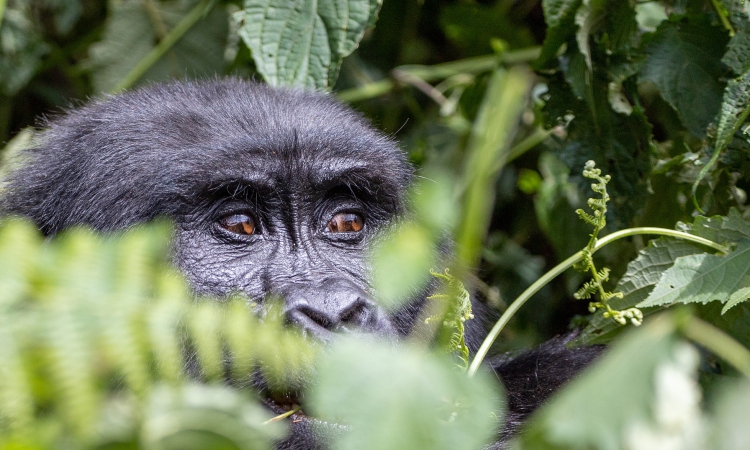
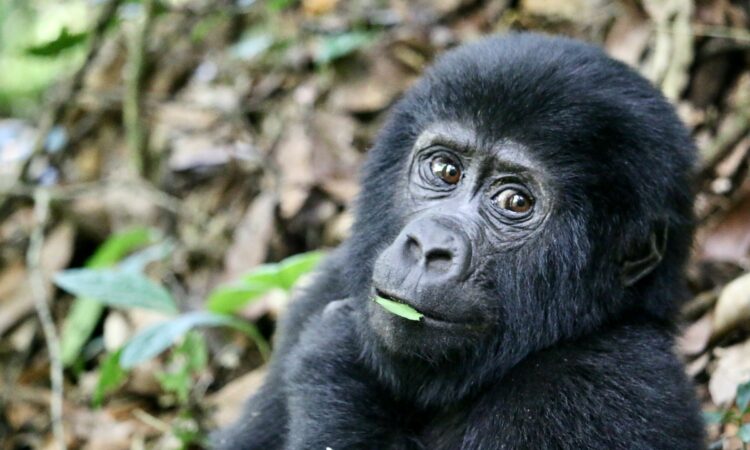
Why are mountain gorillas so important? Over the years, mountain gorillas have been the most endangered primates, and so many conservative measures have been put in place to protect them.
This is why they are important:
- Ecological Importance: Mountain gorillas play a vital role in maintaining the ecological balance of their habitats. They are herbivores and feed on various plant species, including bamboo, grasses, and leaves. By consuming these plants, they help to regulate the growth of vegetation and create a diverse landscape. This diversity is essential for other species, such as birds, insects, and small mammals, that rely on the gorillas’ habitat for survival. For more on their habitat, see Mountain Gorilla Habitat.
- Cultural Significance: Mountain gorillas have a rich cultural significance in the regions where they are found. In Rwanda, for example, gorillas are considered a national treasure, and their conservation is seen as a national priority. The country has invested heavily in gorilla tourism, which has helped to create jobs and generate revenue for local communities. In addition, the gorillas are an important part of the region’s folklore and mythology and are revered as a symbol of strength and resilience.
- Scientific Value: Mountain gorillas are also of great scientific value. Studying their behavior, social structures, and genetics has helped scientists to better understand primate evolution and behavior. Researchers have been able to observe and document the gorillas’ unique behavior, such as their use of tools, communication patterns, and social interactions. This knowledge has contributed to a better understanding of the evolution of human behavior and has helped to advance our understanding of primate conservation. Learn more about their behavior in Mountain Gorilla Behavior and Adaptations.
- Economic Benefits: Gorilla tourism has become an important source of revenue for local communities in the regions where mountain gorillas are found. Tourists come from all over the world to see the gorillas, and this has created jobs.
A mountain gorilla is one of the subspecies of the eastern gorilla (gorilla beringei), which is native to the Virunga mountains in Central Africa.
Currently, mountain gorillas are the most endangered and have a population estimated around 1,040 individuals.
They occupy the Virunga mountain ranges of Uganda, Rwanda, and the Democratic Republic of Congo.
Mountain gorillas live high in the forests on mountains about 8,000 to 13,000 feet.
Mountain gorillas are also widely affected by disease outbreaks, which affect their low birth rates.
Characteristics of mountain gorillas

They have thick silverback fur, which helps them to live in the cold climate of the high-altitude mountains. Adult males have a weight of up to 400 pounds, which is 180 kg.
Adult males also have a height of up to 6 ft (1.8 m) tall. They have broad chests, wide shoulders, and large heads.
Mountain gorillas share 98% DNA with humans, just like chimpanzees.
Behavior and social structure of mountain gorillas
Mountain gorillas stay in groups called troops, which are led by a dominant male silverback. These groups are comprised of many females and their young ones.
The silverback leader of the group is responsible for many group decisions, which include building a nest for the night, movements, and searching for food throughout the day.
The dominant male silverback is responsible for guarding the family and leading them throughout the course.
The dominant male silverbacks are very serious when it comes to their families, in that they can fight for them in case of any threat.
Female gorillas, in most cases, give birth to their first young ones at the age of 10 years, and one female can give birth to up to 6 young ones over the course of its lifetime.
Mountain gorillas feed mainly on leaves, shoots, and fruits.
They also feed on small amounts of insects and small animals.
In conclusion, mountain gorillas are unique creatures, and there is a lot to learn when you go gorilla trekking.