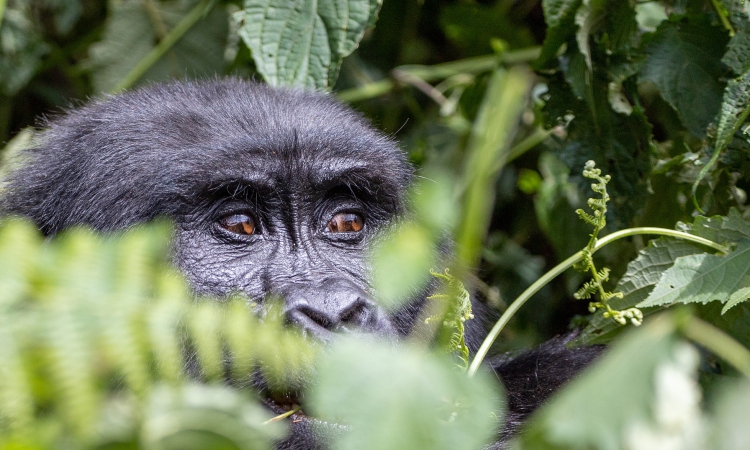

Facts about Mountain Gorillas – A mountain gorilla is one of the subspecies of the eastern gorilla (Gorilla beringei), native to the Virunga mountains in Central Africa.
Currently, mountain gorillas are the most endangered, with a population estimated around 1,040 individuals.
They occupy the Virunga mountain ranges of Uganda, Rwanda, and the Democratic Republic of Congo. For specific locations, see Mountain Gorilla Location Countries.
Mountain gorillas live high in the forests on mountains about 8,000 to 13,000 feet.
Mountain gorillas are also widely affected by disease outbreaks, which impact their low birth rates.

Characteristics of Mountain Gorillas
- They have thick silverback fur, which helps them to live in the cold climate of the high-altitude mountains.
- Adult males have a weight of up to 400 pounds, which is 180 kilograms.
- Adult males also have a height of up to 6 feet (1.8 meters) tall.
- They have broad chests, wide shoulders, and large heads.
- Mountain gorillas share 98% DNA with humans, just like chimpanzees.
Behavior and Social Structure of Mountain Gorillas
Mountain gorillas stay in groups called troops, which are led by a dominant male silverback.
These groups are comprised of many females and their young ones.
The silverback leader of the group is responsible for many group decisions, which include building a nest for the night, movements, and searching for food throughout the day. For more about their Gorilla Behavior and Adaptations, check this link.
The dominant male silverback is responsible for guarding the family and leading them throughout the course.
The dominant male silverbacks are very serious when it comes to their families; they can fight for them in case of any threat.
Female gorillas, in most cases, give birth to their first offspring at the age of 10 years, and one female can give birth to up to 6 offspring over the course of its lifetime.
Diet
Mountain gorillas feed mainly on leaves, shoots, and fruits.
They also feed on small amounts of insects and small animals.
14 Facts about Mountain Gorillas
- Mountain gorillas are the largest of all primates, with adult males reaching up to 6 feet tall and weighing up to 400 pounds.
- Mountain gorillas are herbivores, and their diet consists mainly of leaves, shoots, and fruits. They have large teeth and a strong jaw to help them chew and grind tough plant material.
- Mountain gorillas live in families, called troops, which are usually made up of one dominant male, several females, and their offspring. The dominant male is responsible for protecting the troop, leading them to food sources, and determining movement.
- Mountain gorillas are the most endangered, with only about 1,040 individuals remaining in the wild. The main threats to their survival include habitat loss and fragmentation, poaching, and disease.
- Mountain gorillas can be found in the Virunga Mountains, a range of volcanic mountains that stretch across the borders of Rwanda, Uganda, and the Democratic Republic of Congo. They live in forests and bamboo groves at altitudes between 8,000 and 13,000 feet.
- Despite their size, mountain gorillas are surprisingly agile and can climb trees and move through dense vegetation with ease. They also have a unique way of communicating, using a variety of vocalizations, facial expressions, and body language.
- Adult male mountain gorillas have grayish fur on their backs, which is thought to be a sign of maturity and dominance.
- Female mountain gorillas give birth to only a few offspring in their lifetime, usually after a gestation period of about 8.5 months. The infants are born with a thick layer of fur and are able to climb and follow their mothers within a few months. Females also give birth after a period of 4 to 6 years after their young ones, making 4 to 6 years of age when they can mate again.
- Mountain gorillas have a relatively slow reproductive rate, which makes it difficult for their populations to recover quickly from threats such as poaching and habitat loss.
- Mountain gorillas share about 98% of human DNA, meaning they are exposed to human illness as well.
- Mountain gorillas usually have more than one silverback in a group. Male gorillas normally never leave the group, but they remain and stay obedient to the alpha male, hoping to inherit power. It is usually females that leave.
- Mountain gorillas sleep on the ground and, in most cases, spend their time on the ground. Adult gorillas are very heavy to climb trees every time; they do it when in need of fruits in most cases.
- Mountain gorillas are gentle to humans. They rarely have any problem with humans and they rarely attack them unless threatened or harmed.
- Mountain gorillas don’t eat meat; their diet consists of leaves, shoots, and roots. A single silverback can eat about 18kg of vegetation in a day.
Habitats for Gorilla Troops
- Bwindi Impenetrable National Park in Uganda
- Mgahinga Gorilla National Park in Uganda
- Volcanoes National Park in Rwanda
- Virunga National Park in Congo
- Kahuzi Biega National Park in Congo
Simultaneously, mountain gorillas are very unique and interesting animals, and it’s fun to go gorilla trekking.