
Snakes in Volcanoes National Park Rwanda – Volcanoes National Park, Rwanda, is located on a 160 sq km piece of land in Musanze, Ruhengeri. It is a 2.5-hour drive from Kigali International Airport, Rwanda.
Volcanoes National Park is the oldest national park on the African continent, famous not only for the endangered mountain gorillas but also for various plant and animal species.
The park is renowned for harboring the five Virunga mountains: Mount Karisimbi, Mount Sabyinyo, Mount Bisoke, Mount Gahinga, and Mount Muhabura.
It is also known for its rich vegetation, including rainforests, thickets, swamps, marshes, meadows, alpine forests, and grasslands.
All these features make it an excellent place for adventure.
The vegetation and physical features at Volcanoes National Park greatly affect the climate, making it cool, misty, and sometimes mild, which favor the breeding of both cold- and warm-blooded animals, reptiles, amphibians, birds, and many others, such as snakes, frogs, gorillas, bushbucks, and hyenas.
Snakes are cold-blooded vertebrates that belong to the reptiles, which are highly responsive to their environment; therefore, they are ectothermic.
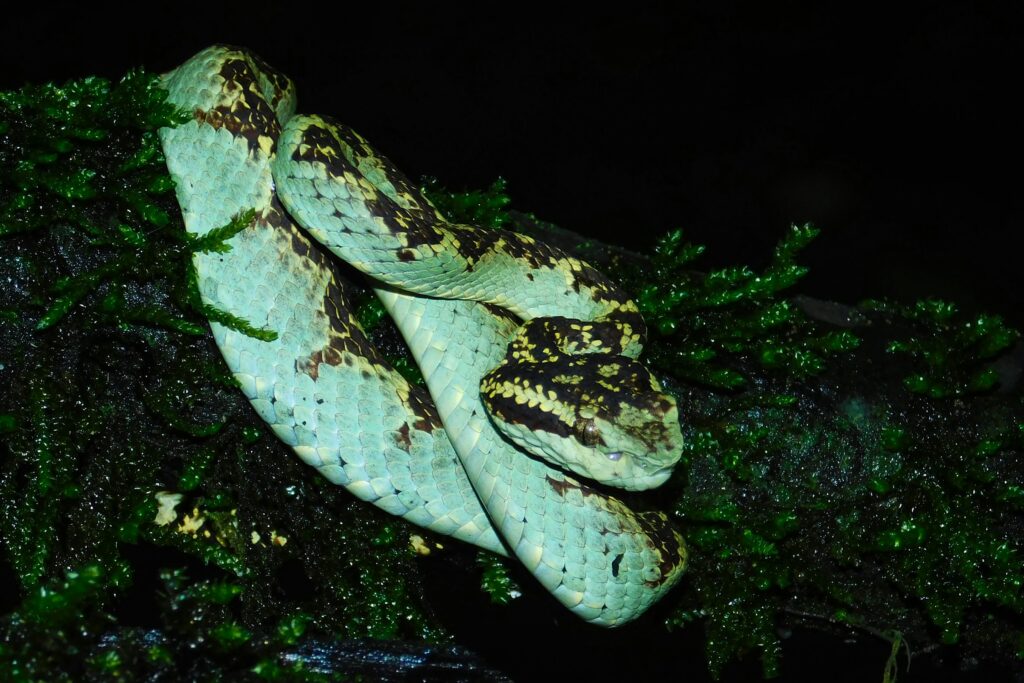
Examples of Snakes at Volcanoes National Park Rwanda
- Great Lakes bush viper (Atheris nitschei)
- Olive house snake (Lamprophis olivaceus)
- Rwanda forest green snake (Philothamnus rwandae) and many others
There are also other types, like Rwanda’s black mamba, which is the most poisonous.
Precautions and safety measures regarding snakes need to be taken seriously.
In case of snake bites, first aid should be administered immediately, and professional services should be provided to patients to save lives.

Snake Adaptations
In order to move and eat, these ectotherms rely on chemical reactions in their muscles, which are highly dependent on temperature changes.
In cold temperatures, the chemical reactions are slow, while in warm temperatures, they are fast.
The chemical reactions become optimal at body temperatures between 70-90°F. Below 60°F, snakes become sluggish.
At extremely hot temperatures, snakes can die due to the destruction of their body organs by excessive heat.
To protect themselves, snakes hibernate until it is favorable to move.
During their growth, snakes molt, shedding their skins and leaving a layer of scales on the ground, signifying growth.

Best Time to Visit and See Snakes
Under strict guidance, tourists can visit and see snakes in very cold conditions, especially in the morning hours when they are completely dormant and not as dangerous as they can be.
In a nutshell, snakes are quite unpredictable creatures, and therefore, people are advised to take precautions seriously at all times.